Coconut Joan

Thursday, May 31, 2007

Playing blocs

When I got to Parker's Piece* for our class football game, Anna and Chris were already there. Bettina soon joined us, and in fifteen minutes, there were ten of us.

'Ten! Perfect! We can have two teams of five.'

'How do we split it? Boys against girls?'

There was a short and lively discussion about the fairness of this arrangement, and how embarrassing it would be when the girls won.

'I know! Let's do Kyoto and non-Kyoto!' someone eventually exclaimed.

'Huh? Oh, you mean...? Would that work? It does!'

And so it was, that the five people from the UK, Trinidad and Tobago, Argentina, and Ireland (countries supporting the 1997 Kyoto Protocol to curb the world's greenhouse gas emissions) played off against the five recalcitrant Aussies and Americans.

'Okay, guys,' said Chris. Chris is from Seattle and is obviously evil. 'Remember, we don't like Kyoto so we can play dirty.'

'Nation's right to pollute!' hollered Ian, a stubborn Australian from Adelaide, as he charged after the ball.

'Voluntary emissions targets!' I yelped, running to the other half of the field in my ignorant and conservative manner.

After fifteen minutes of vicious football, Don arrived.

'Hi guys, sorry I'm late,' he said. 'Whose team am I on?'

'Are you for Kyoto or against Kyoto?'

Without batting an eyelid, Don said, 'Well, Canada's on the fence for this one. But recently, it's been rumbling against mandatory targets...'

'Traitor!' someone cried.

'You're with us, then!' I said, triumphantly.

With six versus five, the global tide soon turned against the Kyoto Protocol. A passerby from Kenya was invited to join the pro-Kyoto side and soon, the game was back on the knife edge.

Who won?

Don't know. We lost track of the score.


* Parker's Piece is a historic place, famous for being the birthplace of modern football (or soccer). There is a plaque on the ground which reads:

"Here on Parker's Piece, in the 1800s, students established a common set of simple football rules emphasising skill above force, which forbade catching the ball and 'hacking'. These 'Cambridge Rules' became the defining influence on the 1863 Football Association rules."
Source: BBC (2006)

Turning up the heat

During my second swing dance lesson in Cambridge, the instructors had us switch our usual roles so that leads (usually boys) would learn how to follow, and follows (usually girls) would learn how to lead. I regularly dance both roles so this wasn't tricky for me (I have the opposite problem in that I sometimes forget if I'm dancing as a girl or a boy).

Of course, the teachers started us off with basic six beat and hand-to-hand charleston. Everyone picked up quickly.

'We're so proud of you all!' the teachers said. 'That normally takes at least twenty minutes. Do you want something harder? We can make it harder for you. Okay, let's make it harder.'

'Yes!' said one of my classmates loudly. 'Let's do it...' He lowered his voice. '...in a ring of fire!'

Wednesday, May 30, 2007

JoanZone

I sometimes have little fantasies about having my own domain name. I couldn't justify the expense, really (the expense being A$13 a year, or COR, BLIMEY! £5, what a bargain). Blogger does me fine.

Anyway, I put 'joan' into a domain name registration search engine and it tells me that the following domain names are available:

  • joan.asn.au
  • joan.id.au
  • joan.net.au
  • joan.org.au
Not bad, not bad. But then the engine went one step further and told me that 'the following domains are similar to the one you requested, and may be of interest.'
  • globaljoan.com.au
  • cheapjoan.com.au
  • joanservices.com.au
  • joanzone.com.au
ORRIGHT! JoanZone!

Parroting

Earlier this year, we had a highly knowledgeable, experienced and opinionated lecturer for an intensive ten day unit. Let's call him Johnson. In those ten days, we had to read the texts Johnson nominated and write essays in response. He wrote many of the nominated texts, which were littered with references to his previous work, as well as other writers who agreed with him. It is a long-running joke amongst my classmates to quote our lecturer, saying, 'Johnson citing Johnson citing Johnson...'

As you might imagine, we got a one-sided view of the topics he covered. Oh, don't get me wrong, it was an extremely worthwhile unit. I have never been so challenged, traumatised and elated by one unit. I'm just amused at the idea of him receiving 106 essays to mark, every one of them parroting his own words back at him.

Well, classmates, in my dissertation research, I have found another author who references himself even more than Johnson does. Meet Leonard Brookes, economist (I think), former head of Forecasting and Energy Policy at the the United Kingdom Atomic Energy Authority and various other energy-related institutes and research councils. I came across him as an author of a journal paper, in which he cited eleven of his own works and various papers by other authors that cite his work.

Most interesting is the fact that he authored the Open University's energy unit. I have found a 1998 paper by a research fellow from Open University. The fellow must have been entirely convinced by Brookes; it is striking how closely his conclusions mirror Brookes's.

I can't tease him too much; I've done the same myself.

However, I hope to avoid it in future. Academic worship is neither attractive nor convincing. Constant self-reference is also... well, something you can only get away with when you're a venerable academic-type.

Tuesday, May 29, 2007

Monbiot tells us: 'Choose Life'

George Monbiot is an environmental and political journalist, who writes for The Guardian. My values and beliefs align closely to his, although he is more radical than I am.

He has some careers advice on his blog, which warns me (and you):

Even intelligent, purposeful people almost immediately lose their way in such [corporate/institutional] worlds. They become so busy meeting the needs of their employers and surviving in the hostile world into which they have been thrust that they have no time or energy left to develop the career path they really wanted to follow. And you have to develop it: it simply will not happen by itself. The idea, so often voiced by new recruits who are uncomfortable with the choice they have made, that they can reform the institution they join from within, so that it reflects their own beliefs and moral codes, is simply laughable. For all the recent guff about “corporate social responsibility”, corporations respond to the market and to the demands of their shareholders, not to the consciences of their employees. Even the chief executive can make a difference only at the margins: the moment her conscience interferes with the non-negotiable purpose of her company – turning a profit and boosting the value of its shares – she’s out.
I had a session with the careers advisor this morning. Both he and I agreed that becoming a chartered engineer should be my key priority. However, Monbiot says, "...be wary of following the careers advice your college gives you."
Nor does this mean that you shouldn’t take “work experience” in the institutions whose worldview you do not accept if it’s available, and where there are essential skills you feel you can learn at their expense. But you must retain absolute clarity about the limits of this exercise, and you must leave the moment you’ve learnt what you need to learn (usually after just a few months) and the firm starts taking more from you than you are taking from it. How many times have I heard students about to start work for a corporation claim that they will spend just two or three years earning the money they need, then leave and pursue the career of their choice? How many times have I caught up with those people several years later, to discover that they have acquired a lifestyle, a car and a mortgage to match their salary, and that their initial ideals have faded to the haziest of memories, which they now dismiss as a post-adolescent fantasy? How many times have I watched free people give up their freedom?
Oh dear.

Monday, May 28, 2007

Food for the weekend

Last Thursday night, I was sitting on the grass chatting with my friends until midnight. Spring had come and the night was warm.

Now, it's pouring with rain. I'm bundled up in my goosedown puffer jacket (sometimes called a 'duvet jacket' or 'fashion travesty').

The good thing about the rain is that it helps me stay inside to read dozens of journal articles (oh my god, there are so many).

Damjan came to Cambridge this weekend and we happily did not much. A friend came over to cook Turkish lamb pilau with us, with strawberries for dessert. We also watched Iron Chef, Giant Lobster Battle. Iron Chef is the best.

Turkish Lamb Pilau

  • 500 g lamb, chopped to mouthful size
  • Small handful of pine nuts
  • 1 tbsp olive oil
  • 1 large onion, sliced
  • 2-3 cups rice (the recipe book says 250 g rice but I just added enough until it looked all right)
  • 500 mL stock (I used chicken but lamb or vegetable is better, apparently)
  • Handful of minut, chopped
  • Some cinnamon (I shook the bottle three times. The recipe suggests two cinnamon sticks).
  • Salt and pepper to taste
  1. Lightly fry pine nuts without oil. Remove from pan.
  2. Fry onion and cinnamon in oil until transparent.
  3. Add lamb. Fry until browned.
  4. Add rice. Fry for a minute. Add stock.
  5. Simmer with lid on for 15 minutes or until rice is soft. You might need to add more water.
  6. Mix in pine nuts and mint.
We served it with cherry tomatoes, grated cucumber in yogurt ('tzatziki'), grated carrot in yogurt ('carrot tzatziki'), and cloudy apple juice. We had stuffed olives too but I forgot to take them out of the fridge. More for me, then.

Sunday, May 27, 2007

Potato and reduced fat mature cheddar frittata

I cooked something yummy from my favourite and only cookbook: 101 One-pot Dishes. It was originally 'potato and mozzerella frittata' and it fed 6 people. I adapted it to make 'potato and reduced fat mature cheddar frittata', which fed one person.

  • 1 tbsp vegetable oil
  • 2 small-medium potatoes, sliced
  • 2 eggs, beaten with 1 tsp salt
  • 1 tomato, sliced
  • grated cheese
  • pepper to taste
  1. Fry potatoes with oil for five minutes.
  2. Spread potatoes across the base of the pan. Pour over the eggs so that potatoes are covered. Simmer for 15-20 minutes.
  3. Add tomato slices over the top. Sprinkle the shredded cheese.
  4. Grill for five minutes. Add pepper to taste

Friday, May 25, 2007

Hazarding a guess

Google displays targeted ads alongside your messages in Gmail. I regularly get automated notifications from Facebook whenever someone posts me a message.

Jenny wrote something on your Wall.

To see what Jenny wrote, follow the link below:
http://url.com/xyz#wall

Thanks,
The Facebook Team
In the absence of context, this is Google Adsense's best attempt at responding to such emails:


Berlin Wall?!

It's the scattergun approach. I guess they're hoping something might stick.

Thursday, May 24, 2007

A fish and chip story

Fish and chips at the Lake District. The observant of you will have noticed that there is actually a photo of chicken and chips. That was mum's dinner. I had cod. See also the evil look on my face just before the packages of piping hot yumminess are opened. That is the look of 'I love fish and chips and I don't have to feel guilty about it at all because junk food on holidays doesn't count because it's unavoidable and now officially sanctioned by mum and dad.'

Everyone and no-one wants to save the world

In the last eight months, I have met and read about many talented and idealistic young people. A few of them have even said they would like to be Prime Minister of Australia or the leader of another country so that they could make real fundamental changes in the world.

We should feel encouraged by such passion and activism in society's youth. For me, the first thing that comes to mind is 'Too many cooks spoil the broth.' My second thought is then, 'That's not really fair, Joan. Democracy isn't like a kitchen. The more people engaged, the better.'

The third thought, which is there all the time, is 'You're on a bandwagon, Joan. It's a tired old thing, naive and egotistical. Why don't you get off and let the others save the world? There seem to be plenty of leaders out there, some of whom will be effective.'

These past few weeks, I've been thinking hard about why I'm an engineer. It often seems futile, designing sludge drying beds for water recycling or developing a green purchasing policy for a company. There are economic and technological systems that need reform out there. Can an engineer ever do more than tinker at the edges?

I was in bed on the edge of sleep and asking myself, 'Why do you want to work on the big picture problems, Joan? Is it ego? You don't trust anyone else to make the 'right' changes? You look down on the very necessary and difficult work of on-ground implementation? You don't want to be a faceless worker bee?'

Then I imagined myself in a happy perfect world in which I didn't have to strive for change. I think that day-to-day I would be content, dancing, visiting friends, eating, taking photos. But without an overarching life goal, I don't think I would be satisfied.

I haven't quite got it yet but it's something to do with 'meaning' and 'purpose' There's something about making a lasting, fundamental difference in the external world that motivates me. It is intrinsic in the fabric that makes up 'Joan'. It might also be a search for approval but not (I believe) power and fame.

Understanding this makes me start to understand that others aren't like me. Plenty of people go on with life without trying to change the world. I often get upset with these people (most of society). To me, it seems selfish to aim for nothing more than to earn enough money so that you can go on annual overseas holidays or have weekend parties or relax in the garden or buy a new car.

But maybe (surely) other people have different things that provide their lives meaning: religion, family, friends, travel and experiences, science and discovery, winning, playing, their business...

Still, I think that there are a lot of people who live their lives without meaning. Sam de Brito wrote about a woman who 'started to cry as she spoke about the goat track her existence had become; a worn, weary path between bed, her desk at work, the couch, then bed again.'

Does my life goal to 'make a difference' make me morally superior than the person whose life goal is to 'step foot in every continent of the world' or 'put my children through private school'?

Rationally, no. Intuitively, I still have trouble accepting that intelligent and caring people can be comfortable not acting on global issues of justice, equity, ecological damage, and the future. The corollary of that is that anyone who isn't an activist cannot be intelligent or caring. Again, rationally, this can't be true but... I still feel it.

I wonder how many formerly idealistic people are laughing at me now? Here I am, just another naive young thing waiting to be processed and brought down by real life.

To boldly go: An evening with Stephen Hawking

“It’s like he’s a rock star,” Alex remarked, as we joined the long queue snaking up the staircase from the entry to the Arthur Goodhart Lecture Theatre in the Law Faculty.

It was Wednesday night on January 24, 2007 and hundreds of people had snapped up seats to hear Professor Stephen Hawking speak on “To boldly go. My life in physics.” Hawking, Lucasian Professor of Mathematics, was giving the first Gates Distinguished Lecture of 2007.

As I found my place in the packed theatre, I thought “holy prophet” was probably a more appropriate descriptor than “rock star.” There were no screaming fans; instead the lecture theatre of people expressed their awe in absolute silence. When Hawking entered, the only sound was the whirr of his motorised wheelchair.

Over the next hour or so, Hawking described his life in that famous synthesised voice, complete with American accent, despite Hawking being entirely British. Hawking did his undergraduate physics degree at The Other Place – “ ‘A very easy course,’ he observed. ‘When they asked what I would do after I graduated, I said, ‘If you give me a First, I will go to Cambridge. If you give me a Second, I will stay at Oxford.’ ”

Hawking was awarded a First, and Oxford’s loss was Cambridge’s gain.

A Twist of Fate

Hawking is humble about the path he has taken to scientific and popular fame. He explained that it could have been very different had he been granted his first choice of PhD supervisor, Fred Hoyle. Hoyle worked in the then-glamorous field of elementary particle physics. “None of my work from that period would have survived,” Hawking said. Instead, Hawking was diverted into the underdeveloped fields of cosmology and gravitation. This twist of fate meant that Hawking found himself in the centre of the most fundamental of debates on the nature of the universe. Did the universe have a beginning? Does it have a fixed mass or is it steady state, with new mass being created to keep density constant? “It is just as well I wasn’t a student of Hoyle, because then I would have had to defend the Steady State Theory,” Hawking mused. That theory was waiting to be discredited by astronomical observations by 1965.

A turning point came when Hawking began to collaborate with Roger Penrose. Penrose’s work allowed Hawking to realise that if stars could form singularities (points of infinite density and zero volume), then there would be singularities at the beginning of space-time.

“It was a glorious feeling, having a whole field to ourselves. It was unlike particle physics where people are falling over themselves to latch onto the latest theory. They still are.”

Betting on Black Holes

The world that Hawking describes is familiar to all of us who are navigating our way through academic research. He told us of egos and competition, chance discoveries, serendipitous meetings, pointless seminars, absent-minded supervisors, and eureka moments (“I can’t compare it to sex but it lasts longer”).

The only difference between Hawking’s world and ours is that he was making (and losing) bets on the nature of black holes, developing theory far ahead of experimental evidence (and being vindicated when technology finally caught up), and bouncing off other unique minds like Penrose and Feynman. He did all this while living with motor neuron disease. Being unable to move or speak without human and computer help has not stopped Hawking from pioneering new scientific theories, writing best sellers like A Brief History of Time, and starring in three episodes of The Simpsons.

“Professor Hawking,” came the final question of the night. “If you could ask God one question, what would it be?”

Hawking took his moments in time to compose an answer. His helper explained that the professor selects his words by tensing the muscles in his right cheek. The presentation had, of course, been largely pre-composed. Answering our questions that night would take longer.

We, who indulge in txt msg and msn chat language without thinking, were willing to wait. Hawking offered a perfectly composed response:

“Why did you make M-theory so difficult?”

Published in the spring 2007 Gates Cambridge Scholarship newsletter

Monday, May 21, 2007

Joangineer

I am putting on my engineer's (hard)hat tomorrow. I have to be an engineer again. I am speaking to 50+ people about why I came Cambridge and why I am a better engineer for it. How to talk about myself in public without sounding like a twat? Interesting problem. I've done it before but I'm afraid I will be twatful tomorrow.

It's surprisingly easy, going back to being an engineer after months of being a social scientist, business student, technology policy scholar, and change agent. Even when I tried to think of non-engineering examples for my 'script', I couldn't. All I came up with was engineering -- it was all about construction and industry and water and sludge. I guess... I guess that's what I am.

I kind of resent it.

You know what I need? I need an engineering role model. I want to talk to engineers that deal with the biggest of big pictures. I want to meet engineers who don't always go for the technical solution (Don't kid yourself, renewable energy is a technical solution. Why aren't you dealing with demand management?). But maybe those that do that aren't engineers, then.

As you can see, I am a bit crazy tonight.

Here is an example of engineering.


Isn't it clever? Instead of using a spring to keep the gate shut, we have something even more low-tech. It's a weight! Attached to a chain! Gravity does it all! How fantabulous.

You know you're an engineer when you plan a trip to Paris and want to go to the Sewer Museum.

Sunday, May 20, 2007

Political Compass Take 2

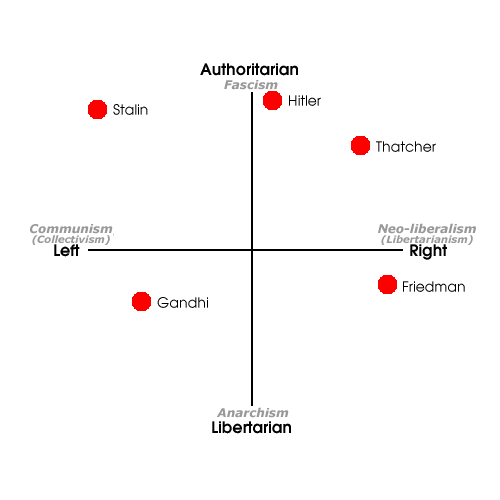
Two and a half years ago, I took the Political Compass test and came out on the Libertarian Left. My scores were:

Economic Left/Right: -2.50
Social Libertarian/Authoritarian: -4.92

Having done this MPhil course, I feel like I have a much deeper understanding of economics, politics, and philosophy. I have just taken the test again. I am still in the Libertarian Left quadrant but check out my scores now!

Economic Left/Right: -7.50
Social Libertarian/Authoritarian: -6.62

Whoa! I'm an angry young Communist Anarchist.

I went for 'strongly agree' and 'strongly disagree' for most questions. It seems like I have definite opinions now.


You know, I consider myself a pragmatic and polite person. I'm hoping that strength of convictions doesn't lead to unreasonableness in action. Strong convictions are good, right? As long as I'm not close-minded, I guess.

For comparison, the following graphs come from the website.


I kind of feel sorry for him

From an opinion article in The Age , which observes the tide of public opinion turning against Australia's Prime Minister, John Howard.

A former Keating government press secretary told a story last week about a recent encounter he had with a Sydney taxi driver. "He was Chinese and I asked him who he would be voting for. He told me that 'All Chinese people will be voting for Rudd because he has a happy face'." And, Howard, conversely, has a sad face.

Unscheduled changing of the guard

Here is Joan, paparazzo, in front of Buckingham Palace.


While we were there, there was a changing of the guard. It was a bit of an unexpected treat because the next one wasn't due until tomorrow at 11:30 AM.


A guardsman appeared in the doorway at the left of the photo and started moving towards the on-duty guardsman stationed in the alcove. He marched very slowly and deliberately.

Stomp.

Stomp.

Stomp.

Stomp.

It went on like this for the three minutes it took for him to get from A to B.

I suppose the unscheduled changeover was finally explained when the travelling guardsman reached the on-duty guardsman and said, 'Your mother's on the phone.'

Saturday, May 19, 2007

Looming unemployment

There was a knock on the front door and because I was the only one home, I went downstairs to open it.

'Do you view the future with fear or hope?' There were two women at my door.

'Erm.' I blinked and thought about it. Well, I still go on, don't I? Despite the war, the injustice, the stupidity and the wastefulness.

'Basically optimism, I guess.'

The woman who spoke looked a little confused. I guess she had been hoping I'd say 'fear' because she went on to read a passage from the bible, assuring me that God was coming take away our suffering.

'The bible tells us we shouldn't face the world in fear. The bible gives us hope because God is coming and will solve all these terrible problems we see in the world these days.'

What I thought was, 'Well, that puts me out of a job.' What I said was, 'Okay.'

'Have you ever thought about the bible?' she asked.

By this time, you readers might be wondering why I was still talking to the Jehovah's Witnesses. Essentially, it was a sunny day and I was enjoying the warmth of standing at the doorway. And I had ten minutes before I had to leave the house.

'No, not really.' Actually, I've thought about the bible before but mostly in a storybook kind of way. I like bible stories but I don't think that's what she was getting at.

She gave me 'The Watchtower', a thin periodical that looks at different bible passages. I had read one a few months ago, which was about how the bible provides guidance on how to make day-to-day decisions like, 'What do I wear?' (nothing too short or sexy) and 'Should I ask her out?' (only if you respect her and intend to take it seriously).

That wasn't the end of the conversation, though, because she asked me what part of China I came from (her husband used to work in Hong Kong). When I said actually, I come from Australia, she and her friend were quite excited because they were from Sydney. We ended up chatting about BBQs and the drought back home.

They promised to come back next week in case I had questions about the pamphlet.

Friday, May 18, 2007

Food as reward

Like many females, I have a love-guilt relationship with food. I have recently become aware of one of my food-related behaviours. I use food as a reward. Whenever I hand in homework, get through a tough day, or even do exercise, I reward myself with food that I would otherwise feel bad about eating.

I don't know if this behaviour is unhealthy or unhelpful. Maybe I reward myself too much or maybe the concept of 'food as reward' reinforces the guilt I feel when I eat food normally.

It leads me to think I need to find alternative ways to reward myself. I read somewhere the suggestion that you could buy a magazine or clothes as a reward. That wouldn't do it for me, really. I haven't yet thought of something that I enjoy as much as food.

Yesterday, I did something that made me happy. I had just handed in an essay. It was only 1000 words long but was very, very difficult and frustrating to write. Instead of buying a food reward, I went spent an hour at Borders. I was very happy and didn't even buy anything.

24 exposures over 24 hours

Some months ago, I had filled in a survey about how I use technology. The researchers then contacted to see if I'd be interested in participating in a 'learning landscapes' study.

They gave me a voice recorder, a disposable camera and a notebook. Every 60 to 90 minutes, I got a text message and had to take photos of my surroundings, and record myself describing what I was doing, how I was feeling, and what technologies I was using. If I couldn't do that, I could jot notes into the notebook. It was a fun day. I ended up going into London to meet people and go to a seminar.

It felt strange taking photos with a film camera, let alone a disposable camera. I couldn't see if the photo had turned out all right. I couldn't take as many photos as I am used to. I have used film cameras before but had never felt the constraints of having only 24 exposures per film. That's because in my film era, I only took photos of the same thing once. In the digital age, I take at least three photos of the same scene using different settings, different perspectives and angles.

Using a disposable camera is no excuse for poor composition. I tried hard to take the best photos I could without being able to adjust aperture, shutter length or film sensitivity. Today, we had a slideshow meeting, where everyone presented their photos and described their day. My photos turned out surprisingly well. The darkest ones must have been thrown out by the developer but otherwise the quality was really quite good.

I think I'll do this again for fun -- buy a disposable camera and practice being hamstrung by low tech and delayed gratification.

Sunday, May 13, 2007

Why we're picky about who we love

I picked up Pride and Prejudice in a second hand bookstore for 75p. It's my third copy of the book.

This time, my reading of it gave me an insight into a possible reason why, in general, people have increasingly high standards about who they are willing to date, marry or shack up with. I've mentioned this before and it seems to be a common enough complaint.

Back in the 1700s and 1800s, women counted themselves lucky if they found a man with enough money to live on and didn't beat you up. Mr Okay was acceptable (I'm simplifying -- the social class was a consideration too). Elizabeth and Jane Bennett were fortunate to find husbands they actually loved and respected but I think most people would have 'settled' as Charlotte Lucas did with Mr Collins.

Our list of 'must haves' is longer now. Not only are we looking for partners that are basically decent people, but they must also be attractive, successful, intelligent, share our interests, and there's got to be 'chemistry'.

Why do we expect to find such perfection in partnership? Why do friends worry about us 'settling' for less than we deserve? Why don't people persevere in okay relationships?

I would like to propose that, alongside female empowerment and the relaxation of social class boundaries, one of the key drivers for our increased fussiness is the invention of the automobile. I heard somewhere that the invention of the car was a revolution in social relations because now, instead of having to marry someone in your village, you could hop over to the next village, or the next, to find a mate.

Because we have more people to choose from, the chances of finding someone compatible in multiple ways has increased. With rising access comes rising expectations.

This leads me to conclude that with the invention of time travel, our demands and expectations will increase yet again. I've always thought that if your Mr or Miss Perfect was the wrong age or born before you or exists in the future, then you'd feel pretty cheated. Time travel would solve that.

And then, we would become even fussier when interplanetary and intergalactic space travel is invented. That opens up the whole field of Mr and Miss Perfects that aren't human. We'd need not settle for any old human ever again.

Friday, May 11, 2007

A worthy cause

You can find the same Big Issue seller outside Sainsbury's in town almost every day. He keeps up a stream of drawling chatter, spruiking to a constant flow of shoppers who walk by without making eye contact. 'Big Issue, someone, anyone, buy your Big Issue here, only thirty to go, help out your fellow man, I've got thirty more copies then I can go home...'

With his experience, he could work as a spruiker for any retail store.

One weekend, Damjan and I were had popped into Sainsbury's for fruit. It was getting late and the Big Issue seller's monologue was still going: 'Only six more copies, buy your Big Issue, I need money to get drunk, I wish I didn't but it's true, buy your Big Issue, six copies to go...'

Thursday, May 10, 2007

8 rotten reasons to apply for a PhD

I picked up the New Scientist Graduate Careers Special (28 October 2006) at the Careers Service yesterday. There is a gem of an article by Matthew Killeya (PhD statistics). This is his list of eight rotten reasons to apply for a PhD.

  1. I want three more years of life as a student.
  2. I've got nothing better to do.
  3. I fancy my lecturer. (!)
  4. I want to pull students ("Don't even go there - much, much worse than pulling your lecturer.")
  5. I want "Doctor" on my credit card ("In fact, most people with a PhD are reluctant to flaunt their title. Imagine somebody introducing themselves as "doctor" in a pub - you'd probably think they were a prat."
  6. They offered me a place.
  7. I'll be raking the cash afterwards.
  8. I want to know all the answers. ("...expect your PhD to throw up more questions than answers.")

Wednesday, May 09, 2007

Life's little tests

One day while I was at the Cambridge town centre, an Asian man waved me down.

'Excuse me, are you Chinese?'

'Oh! Yes.' Then I remembered that maybe I wasn't. 'I mean, no. Well, sort of.' Ah, an interesting problem that I have often pondered...

He looked so alarmed and disappointed that I snapped out of my reverie to say in Chinese, 'But I can speak Mandarin.'

He responded in Chinese. 'Do you know where there is a Chinese food shop?'

I, myself, was heading to the Asian groceries on Mill Road. 'There are a few down that way. They're about ten minutes' walk away.'

'Ten minutes?! Are there any closer ones?'

'Erm...' [What was that word? Oh, I can use another one, I'll use 'groceries'] 'Did you want groceries?'

'No... (something something) ...my wife is over there and wants to eat Chinese food.'

'A restaurant?' I guessed. Phew! This was hard work.

'Yes! Is there one nearby?'

I immediately thought of the Ugly Duckling, the first Chinese restaurant I had visited in Cambridge. The food was good enough, although expensive. It was kind of tricky to explain where it was, so I said, 'There's a map over there. Let's go have a look at it.'

We crossed the road and stood in front of the big tourist map. 'So you keep going up this road, which is just there, and when you get to the round-shaped church, you turn left and it's just there. There's a Thai restaurant there, too.'

He repeated my instructions and once I nodded, he went back to his party.

EXAMINER'S COMMENTS
Good performance with minimal linguistic awkwardness. Some unconventional phrases. 'Round shaped church' was described as 'circle church' but the point was understood and clarified with visual aids. However, the closest suitable restaurant was actually Jinling Noodle Bar on Peas Hill. It is cheaper and tastier than Ugly Duckling.

Comprehension: B
Oral: B+
Content: D

OVERALL MARK: C+

Monday, May 07, 2007

The dancesport haka

I went to the Varsity Dancesport competition between Cambridge and Oxford. The scoring system is very interesting. The competition is split into two levels. The A team is generally better than the B team, with a few exceptions of experienced couples who are not eligible for A team because they're not students of Cambridge or Oxford.

Everyone dances four dances: Waltz and quickstep for the modern ballroom section; and cha cha and jive for the latin section. Everyone ends up dancing the waltz three times, the quickstep three times, and so on. It's set up like a round robin so that different combinations of Cambridge and Oxford couples dance against each other. I believe that by the time all the waltzes are done, every Cambridge couple has waltzed against every Oxford couple, and the audience has sat through about eight or nine rounds of waltz (it could have been more or less -- I couldn't keep track). The algorithm for selecting couples for rounds was a mystery to me. I had no idea what was going on for most of it. Then, of course, it's repeated for the other three dances.

The couples are ranked in each round and awarded points. Cambridge couples' points are aggregated and compared to the sum of Oxford couples' points. The two latin dances are added together, as are the two ballroom. So a score is reported for Cambridge ballroom versus Oxford ballroom, then Cambridge latin versus Oxford latin. The ballroom and latin scores are summed and the winning team has the highest points.

This year, Cambridge won the B Team match for the first time. It also won the A Team match by a long way. It seems that all year, Cambridge has been trumping Oxford. These are the top two university dancesport teams in the UK and they take turns being on top. It would have been quite an experience to dance with the team. I'm sorry I've missed my opportunity.

Here are a few photos I took. No spectacular ones but I was there to enjoy watching the dancing rather than take photos, so anything decent was a bonus.

A quiet moment on the dancefloor.

I tried to pan with the moving couples (that is, follow the couples with my camera while the aperture was open) and actually came up with some clearer ones than this. But I like the colour and the composition here.


This is the Cambridge A Team's 'walk on' for the latin section, which was a pretty cool routine. Think of it as equivalent to the All Blacks's Haka, which is meant to frighten the bejeezers out of the opposition.

For reference, here is the All Blacks's haka... Yep. That's exactly what the 'walk on' was like.

For your information, Tonga (in the red) lost that match 90 to 7. Maybe the Oxford team need to have a chat to our mates in New Zealand...

And now, back to our normal programming -- 'A Team' Latin.


Hey, I stick my tongue out at my dance partners as well!

And here she is, with a more conventional 'dancesport' face.


Friday, May 04, 2007

Welcome white walls

Hardy's Well is a pub in Manchester. With white walls welcoming wise, wicked, and wretched, whither will... Gargh, it's too hard.

Thursday, May 03, 2007

Mightier than the pen

The Lakes District is what the guides call 'the most beautiful corner of England'. There's lots to see, lots to do. When Derek, our B&B host, asked us at breakfast what we had planned for the day, dad said, 'We're going to the pencil museum.'

'The pencil museum?' Derek's eyebrows shot up. 'In Keswick?'

Yes, indeed. The highlight of our day would be the Cumberland Pencil Museum, home to Derwents, the world's first pencil and the world's largest pencil (not the same pencil).

At the museum, I learned about how pencils are made. I had somehow assumed that graphite lead was punched through a tube of wood. Obviously, I hadn't thought too clearly about this because surely the graphite would snap during such a violent operation. I mean, that's what they do when I'm writing in an exam. In actual fact, the graphite is sandwiched between two halves of the wooden shell, then the shell is shaved to make that nice hexagon shape.

I learned that in World War II, Allies soldiers were given special pencils, whose ends could be unscrewed to reveal a compass and secret maps of parts of Germany.

While there, I gawked at the world's largest pencil. It's almost eight metres long and 450 kg. If you could pick it up and draw with it, you could draw a banana or the sun. It probably wouldn't be so good for writing on a Post-It note, though, even if you could write something intelligible on such a small surface.

Finally, we watched a video about the history of the pencil. My favourite part of the film went something like this: 'In a great feat of engineering, Amercians spent ten years to develop a pen that would work in the zero gravity of space. The Russians used pencils.'

Tuesday, May 01, 2007

Triumph of swan propoganda

I used to think swans were special. You can hardly blame me; they have such good publicists. Some of their propoganda triumphs include: countless retellings of The Ugly Duckling; encore performances of Swan Lake; Schubert's relabelled Schwanengesang; and the Sydney Swans being in the AFL grand final for two years running.

You don't see a lot of swans in Australia so to me, they've been mythical beings. When I arrived in England, I was lucky enough to spot a swan on the River Cam. Excitedly, I snapped dozens of photos. SNAP! SNAP! SNAP! I was paparazzo.

In the seven months I've been here, I've come to the realisation that they're everywhere. That's right, swans are everywhere. Common as dirt, and they nearly all belong to the Queen.

Mum's first day in Cambridge: 'Oh, mum, don't bother with that old thing. They're everywhere.'

'Hello, swan, we meet again.'

'Smile for the camera!'

Smiling for the camera.

'What, you call us all the way here and there's no food? We're leaving!'

They left behind a feather as a mark of their disdain.